|
| Duke Ellington Orchestra at Grace Cathedral, 1965 |
by Jesse Hamlin
Fifty years ago, on September 16, Duke Ellington filled the soaring Gothic nave of San Francisco’s Grace Cathedral with the sublime and exultantly swinging sounds of his first “Concert of Sacred Music.” Commissioned by the Episcopal cathedral to help consecrate the new sanctuary, it was an offering to God in Ellington’s expansive idiom that gave the composer the chance, as he put it, “to say openly what I’ve been saying to myself on my knees.”
A deeply religious man, Ellington wove older themes of his like the spiritual “Come Sunday” from his 1943 suite
Black, Brown and Beige with potent new gospel pieces – he wrote the music and the hip lyrics – in a stirring hour-long work brought to life by a great assembly of artists: his jazz orchestra, featuring the peerlessly lyrical alto saxophonist Johnny Hodges and the roaring tenor soloist Paul Gonsalves; the Herman McCoy and Grace Cathedral choirs; the vocal soloists Jon Hendricks, Esther Marrow and Jimmy McPhail; and the mesmerizing tap dancer Bunny Briggs, who seemed to float over the floor like a shimmering hummingbird as he clicked and whirred through a brisk-tempo nine-minute reworking of “Come Sunday” that Ellington called “David Danced Before the Lord with All his Might” (text courtesy of the Biblical Book of Samuel).
“It’s the most important statement I’ve ever made,” Ellington said of the piece, the first of his three sacred concerts, on the eve of its 1965 Grace premiere, which was filmed and aired on public television and, thankfully, can be seen on YouTube. It’s an inspiring performance. To celebrate the piece’s golden anniversary, SFJAZZ has assembled its own estimable cast of artists to recreate the “Concert of Sacred Music” at Grace on September 17.
 |
| Queen Esther Marrow |
Alto saxophonist Miguel Zenón of the SFJAZZ Collective has re-arranged the music for an aggregation that features one of the original singers, Queen Esther Marrow, Kurt Elling in the Hendricks role and Terrance Kelly leading the Oakland Interfaith Gospel Choir and singing one of the solos. Zenón leads a prime 11-piece ensemble that includes trumpeter and new SFJAZZ Collective member Sean Jones, clarinetist Ben Goldberg, tenor saxophonist Melissa Aldana, bassoonist Paul Hanson and SFJAZZ Collective pianist Edward Simon. Stepping into “David Danced Before the Lord” his way will be the wizardly tap dancer Savion Glover, who was a teenage prodigy when he performed with Bunny Briggs in the 1989 Broadway musical
Black and Blue and is supremely suited for this part.
 |
| Bill Frisell at Grace, 2007 |
SFJAZZ has a long tradition of presenting musicians in the Nob Hill cathedral, among them Joe Henderson, Zakir Hussain and Charlie Haden. It’s producing three other promising performances this fall at Grace, where the acoustics — particularly the seven-second echo — provide challenges and musical possibilities. On September 18, the creative and far-ranging guitarist Bill Frisell, a subtle master of space and silence who played solo at Grace in 2007, returns for an evening of improvisation incorporating the natural acoustics and electronic effects.
A hair-raising Gothic Halloween is on the bill for October 31, when the 1925 silent movie classic “Phantom of the Opera,” starring Lon Chaney as the deformed soul who haunts the Paris Opera house, screens in the sanctuary to live accompaniment on Grace’s massive pipe organ by Dorothy Papadakos, the noted organist who plays in the Paul Winter Consort and was formerly the organist at New York’s Cathedral of St. John the Divine. (That’s where Ellington premiered his “Second Sacred Concert” in 1968, and where his funeral was held in 1974. It closed with violinist Ray Nance playing “Come Sunday.”)
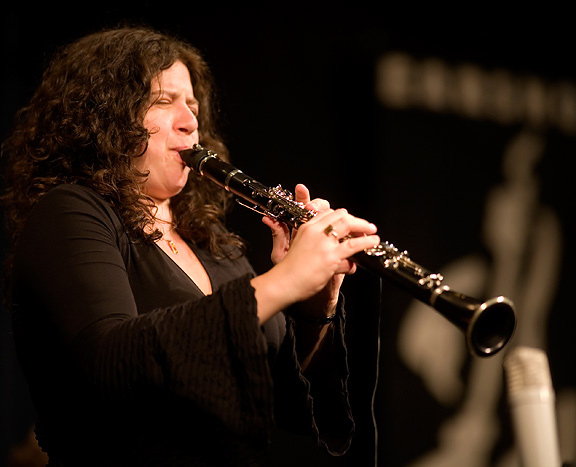
One can only imagine the rich woody sounds that will reverberate through those Gothic vaults on November 12, when four marvelous jazz clarinetists – Don Byron and Anat Cohen, playing B flat clarinet, and David Murray and Todd Marcus on the big bass clarinet – come together to make music in that inspiring space.